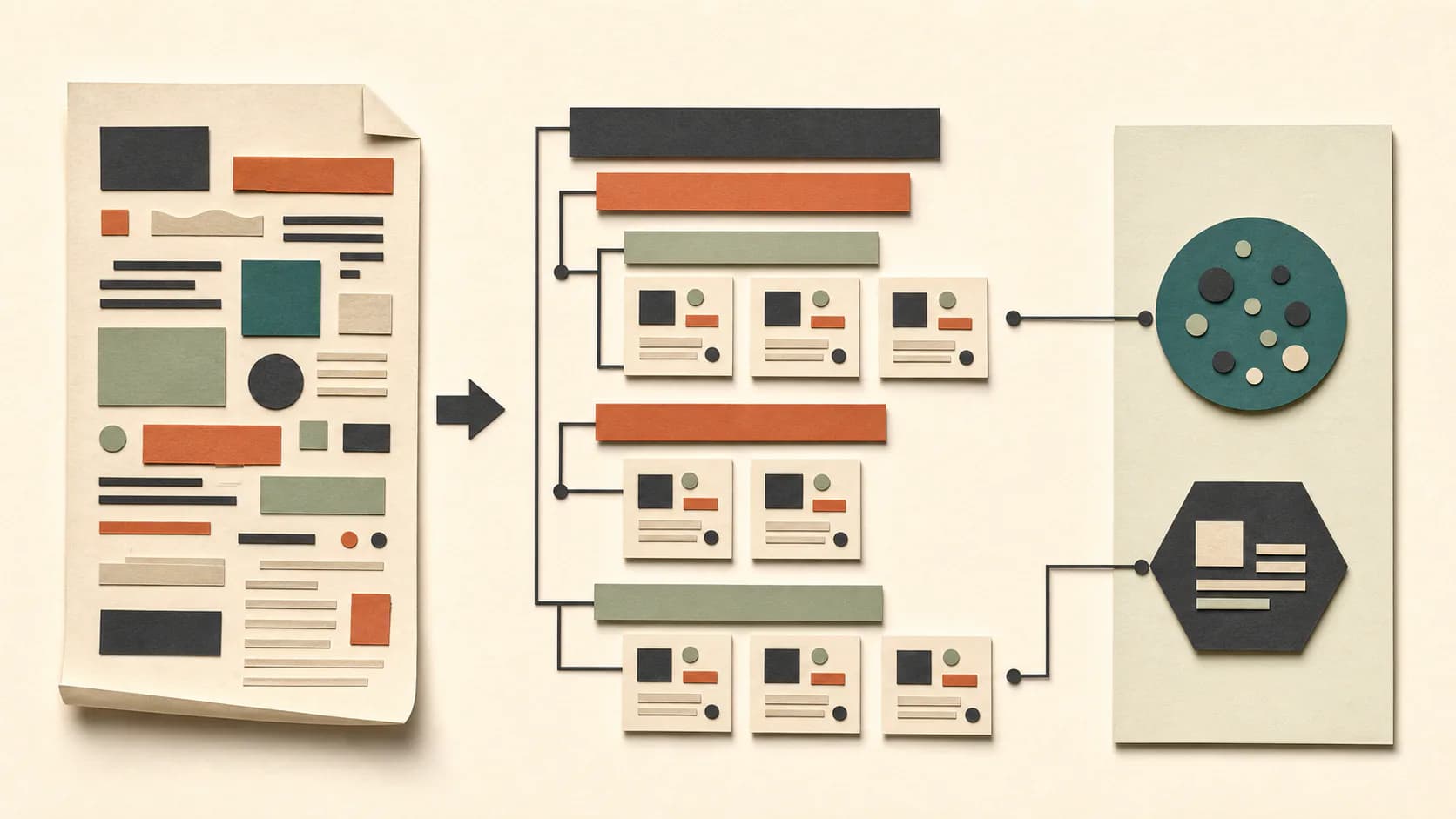
To train a chatbot on your website usually means collecting approved public content, indexing it, retrieving relevant passages for each question, and generating an answer from that evidence. In most managed website-chatbot setups, it does not mean changing a base language model's weights for every page. That distinction matters because each layer fails differently.
Useful website chatbot training therefore starts with source decisions, not an upload button. Decide what the system may use, prepare those pages for retrieval, record their versions, and test both answerable and unanswerable questions. Treat every citation as something to inspect—not as automatic proof that an answer is correct.
Michael Shamanoff Founder, Achla AI
How: This guide uses official Google Cloud and IETF documentation reviewed on August 3, 2026, plus Achla’s local product artifact. No product result or benchmark was measured.
What does “training a chatbot on a website” mean?
The phrase often compresses four separate operations. For a useful RAG vs fine-tuning decision, identify which operation you actually need. Google Cloud describes fine-tuning as further training a pretrained model on task-specific data and contrasts it with retrieval-augmented generation, which augments a prompt with external knowledge. Its current tuning documentation also describes supervised fine-tuning as learning from labeled examples and updating model parameters. (Fine-tuning overview; tuning documentation)
| Layer | What changes | Website-owner question | Typical response to an update |
|---|---|---|---|
| Fine-tuning | Model parameters or adapters learned from a training dataset | Does the task require behavior, format, or style adaptation? | Prepare labeled examples, tune, evaluate, and version the model. |
| Indexing | A searchable representation of approved content | Which pages and sections are discoverable and current? | Crawl or import the changed source and refresh the content index. |
| Retrieval | Evidence selected for one query | Did the system find the passage that answers this question? | Improve the source, chunking, metadata, embeddings, or retrieval configuration. |
| Generation | The response composed from retrieved context | Does every material statement stay within the evidence? | Narrow instructions or grounding controls and replay the test. |
This diagnostic model does not describe every vendor's proprietary pipeline. Products may combine steps or retrieval techniques. A crawl does not prove indexing, retrieval does not prove the right passage was selected, and a source link does not prove claim support.
Decide which website content the chatbot may use
Before you build a chatbot from website content, inventory public, current, useful, and authorized pages. Assign each source one decision:
| Decision | Use it when | Next action |
|---|---|---|
include | The public page has a clear, current answer and an accountable owner. | Record its URL, version or update date, and expected questions. |
fix first | The topic belongs in scope, but the page is ambiguous, stale, contradictory, or incomplete. | Repair the canonical source before indexing it. |
exclude | The page is duplicate, navigational, irrelevant, obsolete, or likely to confuse retrieval. | Keep it outside the source set and record why. |
unsupported/private | Access requires credentials, a private network, customer context, or authorization the workflow does not have. | Do not bypass the boundary; choose a supported source or use case. |
Keep robots rules separate from access control
RFC 9309 defines the Robots Exclusion Protocol as rules crawlers are requested to honor and explicitly says those rules are not access authorization. It also recommends real application-layer security, such as HTTP authentication, for protected paths. A disallow rule can reveal a path; it does not make the resource confidential. (IETF RFC 9309)
Do not put credentials in crawl URLs, bypass login walls, or treat employee-only, customer-specific, regulated, intranet, or private-network material as public. Achla's crawler checks robots decisions, rejects credential-bearing URLs, and blocks private or internal targets. This does not support private knowledge-base ingestion.
Prepare and index website content for useful retrieval
To index website content for AI, make each section understandable when retrieved away from its page. Crawled text can still be a poor answer source.
- Give each section a descriptive heading matching its question.
- Put the direct answer nearby, then add conditions, exceptions, dates, and examples.
- Keep one stable canonical owner for the fact; resolve duplicate or contradictory pages.
- Use consistent names for products, plans, policies, and technical concepts.
- Record the source URL, meaningful update date, access result, robots result, and questions it should answer.
Separate crawl readiness from answer readiness:
| Observation | What it proves | What it does not prove |
|---|---|---|
| The crawler fetched a page | The page was reachable during that run. | The useful section entered the index or will be retrieved. |
| The page appears in the content index | A searchable representation exists. | The correct passage wins for a particular query. |
| A passage was retrieved | Evidence was selected for that query. | The generated answer faithfully uses all conditions in it. |
For a deeper source-editing workflow, see how to prepare website sections for retrieval. Do not prescribe refresh buttons, schedules, or indexing times unless the selected product documents and exposes them.
How do you keep chatbot knowledge up to date?
To keep chatbot knowledge up to date, use refresh and replay rather than “retrain.” Google Cloud distinguishes automatic, manual, and sitemap-based refresh, defining refresh or recrawl as fetching and indexing the latest page. (Refresh web pages)
- Save the old source version and a fixed test query.
- Publish the authorized correction to the source of truth.
- Trigger or await the vendor-supported recrawl or refresh mechanism.
- Verify that the changed page or version is discoverable in the content index.
- Replay the same query and compare the answer, citations, and human support verdict.
Do not infer an Achla refresh schedule, service level, or instant update from this vendor-specific Google documentation. Freshness is an observed state: the reviewer should identify which source version was available when the answer was tested.
Require website chatbot citations, but verify their support
A grounded answer is easier to audit when the interface exposes its sources. Google Cloud's answer documentation defines an answer as AI-generated text based on search results and provides options for citations and claim-level grounding support. Those are verification mechanisms, not a universal correctness guarantee. (Get answers and follow-ups)
Review each material statement with three questions:
- Does the cited page contain the relevant passage?
- Does that passage support the whole claim, including conditions, scope, and date?
- If evidence is absent or partial, should the answer narrow itself, ask a question, or return a bounded miss?
| Claim state | Citation state | Reviewer decision |
|---|---|---|
| Fully supported | Relevant source and passage are inspectable | Accept this claim for the test row. |
| Partially supported | Source covers only part of the statement | Narrow the answer and replay. |
| Contradicted | Source says something materially different | Reject the answer and locate the failed layer. |
| Not assessable | Source or passage is unavailable to the reviewer | Record the limit; do not guess. |
Achla's inspected widget code can render inline citation markers, a source list, and a visible no-answer state. This proves current interface behavior only. It does not prove that every answer is correct or that every citation supports every claim. See how grounding and citations limit an answer.
How should you test a chatbot trained on website content before launch?
Use a fixed Website-Training Readiness and Replay Record. It turns a subjective demo into an inspectable decision without inventing a pass percentage.
Build a fixed question matrix
Include at least these case classes:
- one answerable from a single clear public page;
- one requiring two approved pages;
- one only partially answerable because a condition is missing;
- one stale case after a known source change;
- one absent-evidence question that should produce a bounded miss;
- one private or forbidden-data question that must not reveal unavailable material;
- one ambiguous question that should prompt clarification or a narrow response.
For every row, record:
test_id; exact query; case class; expected source URL(s); expected evidence or absence; source version/date; refresh or index version if available; observed answer or miss; returned citation URL(s); human support verdict; likely failure layer; next action; reviewer; observed_at.
This is a protocol, not an Achla result. No fixed-question demonstration was run; observed answers, citations, rates, and outcomes remain unknown.
Locate the layer that failed
- Source failure: the website lacks a clear, current answer. Fix the source of truth.
- Access/index failure: an authorized public source is unavailable to the crawler or stale in the index. Resolve access or refresh.
- Retrieval failure: the right source is indexed but the expected passage is not selected. Inspect content structure and retrieval.
- Generation/support failure: the evidence is present but the response adds, omits, or contradicts a material condition. Narrow the answer and retest.
- Citation-rendering failure: evidence may have been used, but the reviewer cannot inspect it. Do not call the response verifiable.
- Not assessable: hidden system evidence is unavailable. Record the limit instead of guessing.
Make a bounded decision
Send the use case to human launch review only when business-critical positive cases have visible supporting evidence, critical absent/private cases stay bounded, and every warning has an owner. Revise and replay when a concrete source, access, freshness, retrieval, generation, or citation fix exists. Do not launch that use case when required sources are unsupported/private, critical claims remain unsupported, or the evidence path cannot be inspected.
Use a versioned sheet to record and replay claim-level evidence rather than replacing failed rows with easier questions.
Managed website chatbot, custom RAG, or fine-tuning?
The best operating model depends on the control you need and the work your team can own.
| Approach | Best fit | What the team still owns |
|---|---|---|
| Managed website chatbot or search | Public-site sources, generated answers, citations, and an embed without operating the complete retrieval backend | Source scope, source quality, access decisions, testing, and review; product capabilities vary. |
| Custom RAG | Control over ingestion, retrieval, authorization, evaluation, and integrations | Architecture, infrastructure, security, refresh, observability, and ongoing evaluation. |
| Fine-tuning | Behavior or task adaptation backed by suitable labeled examples | Dataset quality, training, model evaluation, deployment, and monitoring. It does not replace retrieval of changing website facts. |
Achla's product artifact describes managed AI search for public website content: the owner embeds a script instead of operating the complete answer backend. It also renders sources and a no-answer state. These are implementation facts, not outcome promises. Read what a managed setup removes—and what the owner still must test.
Common website chatbot training mistakes
- Calling ingestion fine-tuning. Name indexing, retrieval, generation, and parameter tuning separately.
- Indexing every page. Make an explicit include, fix, exclude, or unsupported decision.
- Treating robots.txt as privacy. Use authentication and authorization for protected material.
- Assuming a crawl proves retrieval. Test the exact question and inspect the returned evidence.
- Treating any citation as support. Check the passage, conditions, scope, and date.
- Testing only easy questions. Add partial, absent, stale, private, and ambiguous negative test cases.
- Updating content without replay. Verify the refreshed version, then repeat the same query.
FAQ
Can you train a chatbot from a website?
Yes, if “train” means using authorized website content as a retrieval source. The usual workflow is to select public pages, prepare them, crawl or import them, index them, and test generated answers. It does not necessarily fine-tune the base model.
Is training a website chatbot the same as fine-tuning?
No. Fine-tuning changes model parameters or learned adapters using training examples. A website chatbot commonly retrieves current passages from a content index and provides them as context at answer time. A product can use both, but they solve different problems.
How does RAG use website content?
RAG searches an approved knowledge source for relevant information and adds selected context to generation. Implementations vary: some use embeddings, keyword signals, or hybrid retrieval. Test the expected passage for each important query instead of assuming the architecture guarantees support.
How often should website chatbot content be refreshed?
Refresh after meaningful source changes and according to the selected product's documented mechanisms. Avoid a universal schedule. Record the source version, verify the refreshed version is searchable, and replay fixed questions so freshness is observed rather than assumed.
Can a public website chatbot use private or login-protected data?
Only if the product has a separately verified, authorized private-data workflow. A public website crawler should not bypass login walls or ingest credentials, private-network resources, or unauthorized data. Achla private knowledge-base ingestion is not supported by the evidence reviewed for this article.
Limitations and next step
Vendor architectures, crawl controls, indexing behavior, refresh timing, retrieval methods, and citation behavior vary. A current source can be missed; a retrieved passage can be misused; a citation can be irrelevant or incomplete. Robots rules are not authentication, and public-site crawling is not a private-data connector. This guide provides a review protocol, not legal advice, a security certification, a benchmark, or a guarantee of accuracy, ranking, conversion, ticket reduction, or launch time.
If a managed public-site workflow fits your scope, connect your site, start with a small authorized source set, and run the fixed positive and negative matrix. Treat the result as evidence for a human decision—not automatic approval to launch.